In plain English: more days, more traffic, earlier timing, more ad tools, and a $24.1B baseline. Every factor points the same direction.
01The Data Behind Prime Day’s Growth: Why 2026 Is the Inflection Point
Amazon Prime Day 2026 runs June 23–26. But the significance of this event is not just about four days of discounts. It is the result of 11 years of compounding growth that has turned what started as a one-day clearance event into the largest annual online shopping event in the United States.
The Prime Day Growth Timeline
02Why Four Days Changes Everything for Sellers
Moving from a two-day to a four-day Prime Day in 2025 was not just a doubling of opportunity — it changed the fundamental structure of how sellers should approach the event. The same applies and amplifies in 2026.
More Days Mean More Total Sales Volume
The straightforward arithmetic: two extra days of Prime Day traffic means roughly 2x the baseline conversions — if inventory holds. But the actual multiplier is higher. Day 3 and Day 4 of Prime Day capture shoppers who did not buy on Days 1 or 2. These are the “consideration” buyers who needed more time. A four-day event converts them. A two-day event loses them entirely.
Real-Time Optimisation Between Days
A two-day event leaves no time to learn and adjust. A four-day event does. Sellers who analyse Day 1 data — which search terms converted, which campaigns exhausted budget too early, which products showed unexpected demand — and adjust for Days 2 through 4 consistently outperform sellers who run a static four-day campaign. This is a structural advantage that only exists in a multi-day format.
| Dimension | 2-Day Format (Pre-2025) | 4-Day Format (2025–2026) |
|---|---|---|
| Total sales window | 48 hours — all-or-nothing | 96 hours — recover from Day 1 errors |
| Consideration buyers | Lost — no time to return | Captured on Days 3–4 after initial browsing |
| Campaign optimisation | Zero real-time learning | Full Day 1–2 data before Days 3–4 |
| BSR velocity | 2-day spike, quick decay | 4-day sustained velocity, stronger rank lift |
| Inventory risk | Shorter window to stock out | More days means more units needed — but more revenue upside |
| Upper-funnel ROI | Sponsored TV barely pays back in 48 hours | 4 days makes Sponsored TV investment fully justified |
The BSR Velocity Advantage
BSR (Best Seller Rank) on Amazon responds to sales velocity. Every Prime Day sale contributes to your velocity score. Four days of elevated velocity creates a stronger, more durable BSR improvement than two days — because the algorithm weights sustained signals higher than single-day spikes. The organic rank improvement from Prime Day 2026 will be measurably stronger than any previous two-day event produced.
03The June Timing: Why Amazon Moved Prime Day and What It Unlocks
Amazon moved Prime Day to June for the first time since 2021 — and the decision was deliberate, strategic, and good for sellers who understand what it means.
Amazon Prime VP Jamil Ghani stated directly: “This year, we have the FIFA World Cup. We’ve got also the 250th anniversary of US independence, and so we thought this week was the best week for us to hold Prime Day.” The company wanted a clean window of consumer attention before those events dominated spending patterns.
What June Timing Means for Consumer Spending
June is the start of summer spending season in the US. Back-to-school buying has not yet begun (August–September). July 4 spending has not yet launched. World Cup viewing setups are actively being purchased. Households are focused on outdoor, entertainment, home, and sports — broad, high-value categories where Amazon has strength and where Prime Day discounts convert well.
For sellers, June timing means competing for consumer attention before — not during — the crowded Q3 retail calendar. The July competition from Target Circle Week, Walmart+ Week, and other competing events is largely absent in June. Amazon gets a cleaner shot at consumer attention than it has had since 2021.
The 2021 Comparison Is Not Useful
Some sellers are drawing comparisons to the last June Prime Day in 2021 to forecast 2026 performance. This comparison is largely irrelevant. In 2021, Prime Day ran for two days; 2026 runs for four. In 2021, the advertising landscape had no Sponsored TV for sellers, no Rufus, no Full-Funnel Campaigns. Consumer behaviour, mobile shopping penetration, and Prime membership in 2026 are incomparable to 2021 baselines.
04FIFA World Cup + Prime Day: The Demand Multiplier Most Sellers Are Ignoring
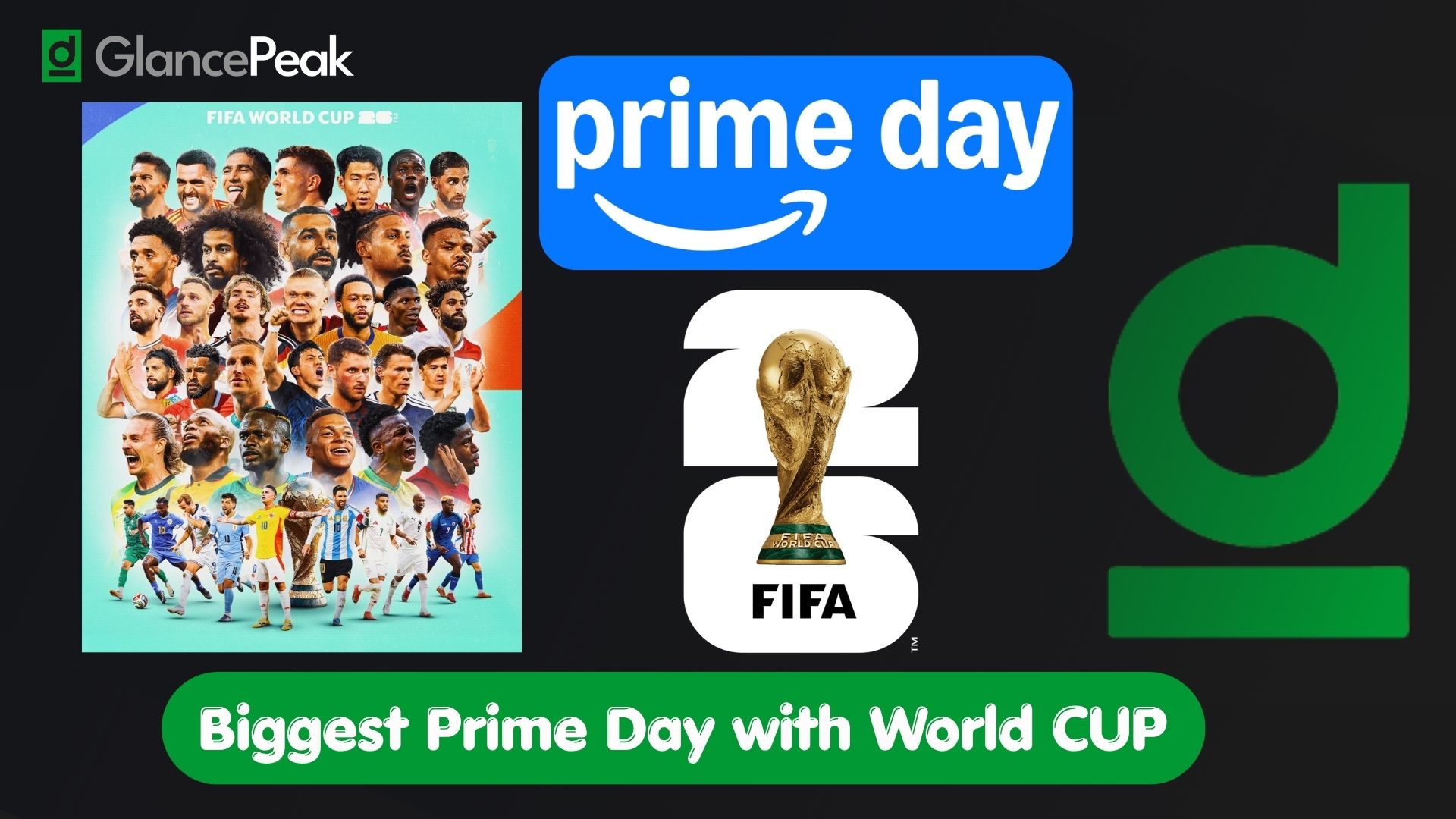
The FIFA World Cup 2026 runs June 11 through July 19 in the United States, Canada, and Mexico — the first World Cup held in North America since 1994. It is the largest single sporting event in human history by global viewership, drawing an estimated 3.5 billion viewers across the tournament.
Amazon explicitly cited the World Cup as a factor in the June Prime Day timing decision. The company wants Prime members to use Prime Day to stock up on groceries and household essentials for World Cup celebrations. But the opportunity extends well beyond groceries.
Categories with FIFA World Cup Demand Layered on Top
- →Electronics and TVs — World Cup drives the single largest annual spike in TV purchases in the US. 4K TVs, soundbars, streaming sticks, and smart home displays all benefit.
- →Outdoor entertaining — Portable speakers, outdoor furniture, gas grills, coolers, and folding seating all spike during major outdoor viewing event periods.
- →Sports merchandise and equipment — Football-adjacent gear, sports apparel, training equipment, and fan merchandise all see elevated demand during tournament periods.
- →Groceries and beverages — Amazon is directly promoting grocery deals for World Cup celebrations. Sellers adjacent to food, snacks, and entertaining see elevated organic traffic.
- →Home improvement — The US Independence 250th anniversary on July 4 drives patriotic home decoration, outdoor improvement, and entertaining equipment in the weeks before the holiday.
05New Advertising Tools Available for the First Time This Prime Day
Every previous Prime Day was run on an older version of Amazon’s advertising capabilities. Prime Day 2026 is the first event where sellers have access to the full suite of capabilities announced at Amazon Unboxed 2025 — and that changes the competitive landscape significantly.
- Full-Funnel Campaigns — single campaign structure across awareness, consideration, and conversion
- AI Creative — generates lifestyle images and video from product photos for Sponsored Brands
- Rufus Ads (expanded beta) — sponsored placements inside Amazon’s AI shopping assistant
- Amazon Marketing Cloud (AMC) — multi-touch attribution now available to all advertisers, not just DSP
- Streaming audio ads — Amazon Music and Alexa audio inventory now accessible without DSP
- Smaller sellers can run full-funnel strategies that previously required agency-level expertise
- Professional creative no longer requires a photoshoot budget — AI Creative fills the gap
- Rufus Ads reach shoppers at the conversational discovery stage, before they search
- AMC measurement shows exactly which ad touches led to Prime Day conversions
- Audio ads reach Prime members through Alexa during the event, a first for most sellers
Sponsored TV is also available with no minimum spend for the first time — any brand-registered seller can run streaming video ads on Prime Video. For sellers who built Sponsored TV awareness campaigns in the three weeks before June 23, Prime Day audiences will be warmer than any cold-traffic PPC campaign could achieve alone.
06Prime Day’s Lasting Impact: BSR, Organic Rank and Q4 Positioning
The sellers who most undervalue Prime Day treat it as a 4-day revenue event. The sellers who most benefit from Prime Day treat it as a Q3 and Q4 investment. The difference in outcome between these two approaches is significant — and entirely predictable from the data.
The BSR Flywheel: How Prime Day Pays Dividends for Months
Prime Day sales velocity feeds directly into Amazon’s organic ranking algorithm. Higher sales velocity → improved BSR → higher organic search placement → more organic traffic → lower effective advertising costs. A seller who generates 5x their normal daily sales volume across 4 days builds a velocity signal that the algorithm uses to rank them for weeks after the event closes.
Sellers who enter Black Friday with a strong Prime Day BSR baseline consistently see better Q4 results than those who did not participate meaningfully in Prime Day. The compounding effect of a strong summer ranking carries forward — and the ranking benefit costs nothing to maintain if organic traffic continues flowing.
Prime Day as a New Product Launch Accelerator
ASINs launched 6–8 weeks before Prime Day enter the event with initial reviews and sales velocity established. Prime Day traffic then accelerates their rank dramatically — what might take 3 months of normal PPC to achieve organically happens in 4 days under Prime Day conditions.
07The Sellers Who Will Miss Prime Day 2026 — and Why
Not every seller benefits from Prime Day equally. Some sellers will see the event come and go with little impact — not because Prime Day failed them, but because specific preparation gaps prevented them from capturing the opportunity.
The Three Preparation Failures That Cost Sellers Prime Day
The Alignment Is Unprecedented. Is Your Account Ready for It?
Four days. June timing. FIFA World Cup demand. $24.1 billion baseline. New advertising tools. The factors behind Prime Day 2026 will not all line up like this again. Sellers who treat this as a normal Prime Day will underperform against those who recognise what is actually available.
GlancePeak’s free Prime Day readiness audit takes 48 hours. We review your listing conversion quality, PPC campaign readiness, inventory position, and deal submissions — and tell you exactly what to fix before June 23.
Book Your Free Prime Day Audit → Send Us a Message