In plain English: same costs, less time. The sellers who win Q4 2026 are the ones who work backward from the October inventory deadlines instead of scrambling in November.
01What’s Different About Q4 2026
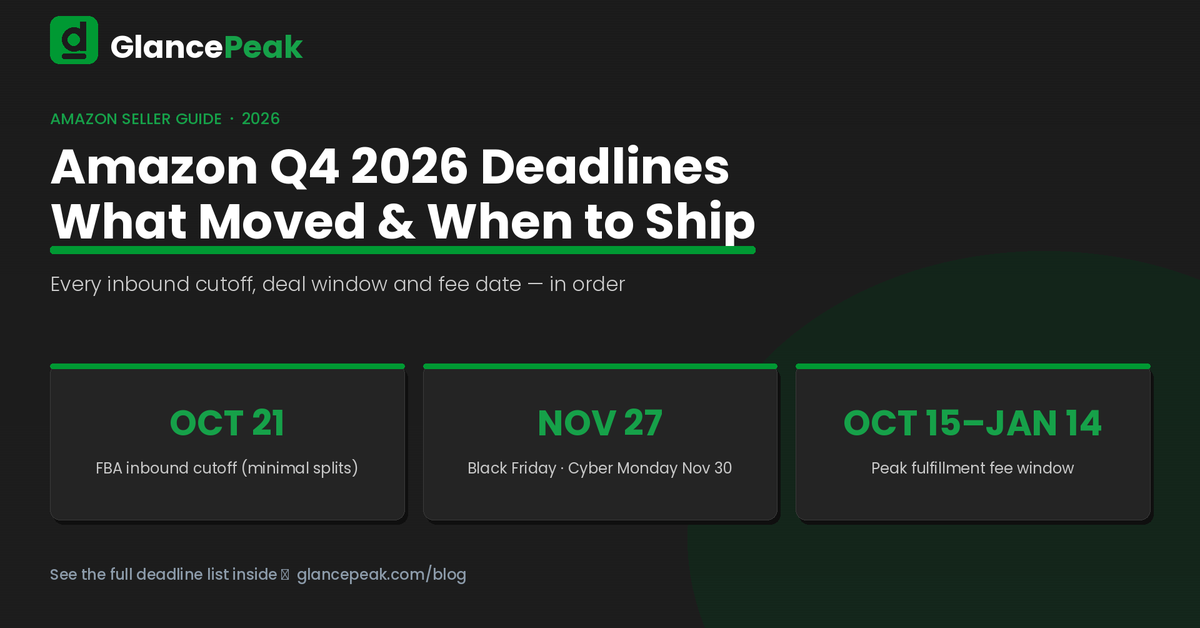
The Amazon Q4 2026 deadlines are earlier than ever, and missing one can define your entire year. Q4 has always been the quarter that makes or breaks an Amazon seller. For most sellers it is 30–40% of annual revenue compressed into twelve weeks, and for gift-heavy categories like toys and holiday products it can reach 50–60%. That part hasn’t changed. However, what has changed is the structure around it.
Same Fees, But an Earlier, Tighter Calendar
Amazon posted its holiday readiness announcement in July under a telling title: “Same fees, same eligibility, earlier deadlines.” Fees are frozen at 2025 levels and no new eligibility rules are coming — but the inbound cutoffs moved earlier and the receiving windows got shorter. Moreover, Prime Day landed in June this year rather than July, which means the promotional calendar is now spread across three quarters and many sellers have already spent part of their inventory budget before Q4 even begins.
02Every Confirmed Deadline (The Ones You Can’t Miss)
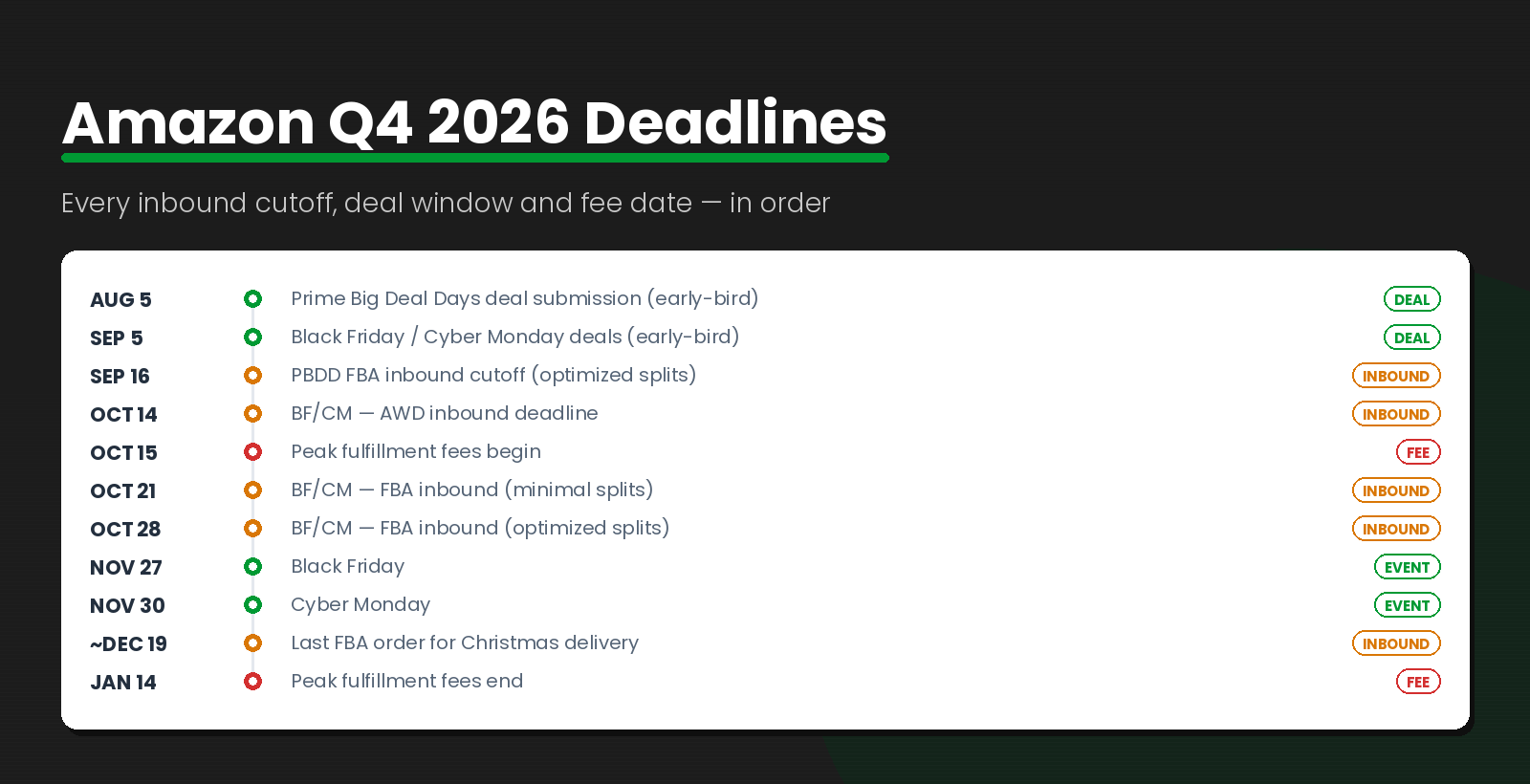
The Full Amazon Q4 2026 Deadlines Table
These are the Amazon Q4 2026 deadlines Amazon has published. Notably, you should treat the inbound deadlines as hard stops, not targets — fulfillment centers shift from receiving inbound stock to processing customer orders as the season progresses, so receiving times lengthen and capacity tightens the deeper into the quarter you go.
| Event / Milestone | What it is | Date |
|---|---|---|
| PBDD deal submission (early-bird) | Save $50/deal on Prime Big Deal Days | Aug 5 |
| BF/CM deal submission (early-bird) | Save $50/deal on Black Friday & Cyber Monday | Sep 5 |
| PBDD FBA inbound (optimized splits) | Stock in for Prime Big Deal Days | Sep 16 |
| BF/CM deal submission closes | Final window for Black Friday deals | Oct 20 |
| Peak fulfillment fees begin | Higher per-unit fees start | Oct 15 |
| BF/CM — AWD inbound | Amazon Warehousing & Distribution cutoff | Oct 14 |
| BF/CM — FBA minimal splits | Inbound cutoff, minimal shipment splits | Oct 21 |
| BF/CM — FBA optimized splits | Inbound cutoff, Amazon-optimized splits | Oct 28 |
| Black Friday | Highest-traffic day of the year | Nov 27 |
| Cyber Monday | Second highest-traffic day | Nov 30 |
| Last FBA order for Christmas (est.) | Guaranteed Christmas delivery cutoff | ~Dec 19 |
| Peak fulfillment fees end | Return to standard rates | Jan 14 |
03The Peak Fee Math That Wrecks Q4 Margins
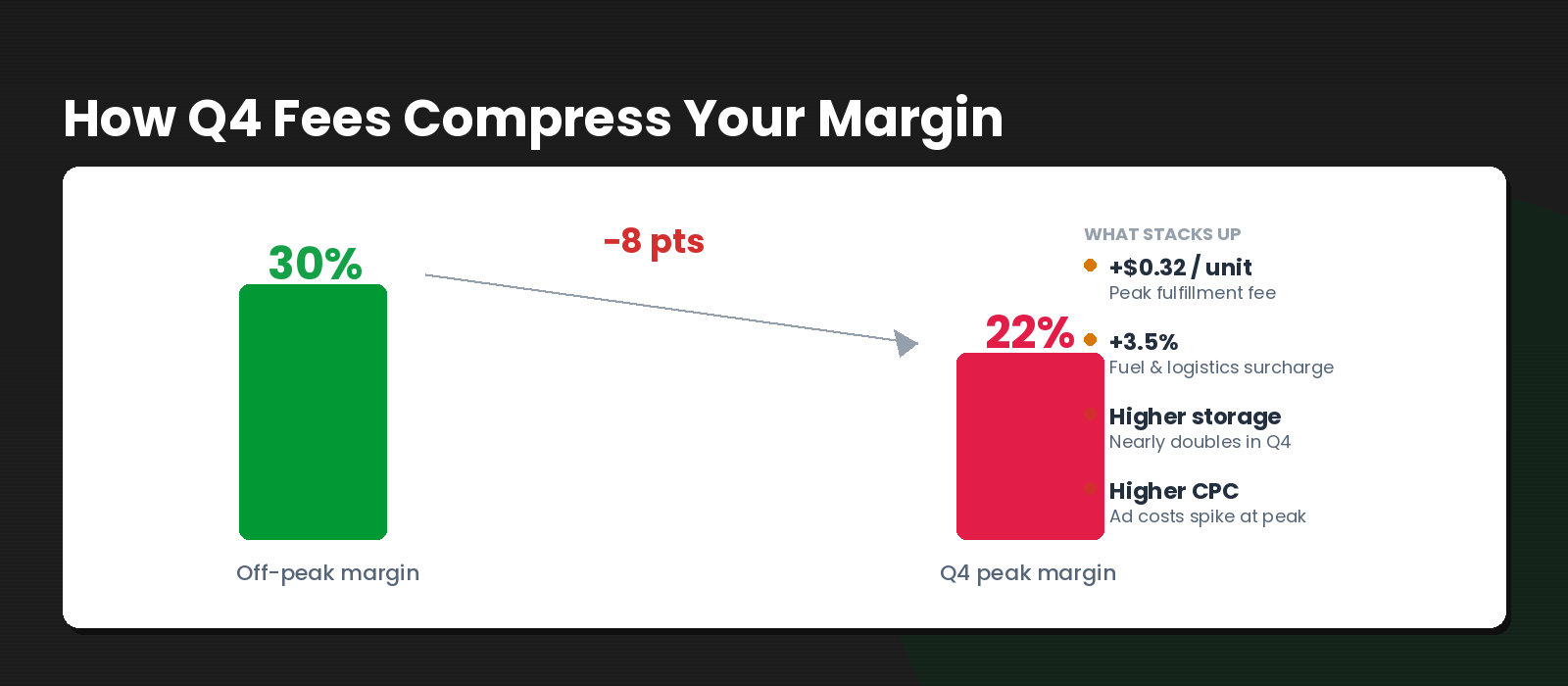
The single most common Q4 mistake is discovering the peak fees in the October invoice instead of pricing for them in August. From October 15 through January 14, every unit fulfilled through FBA, Remote Fulfillment, Multi-Channel Fulfillment or Buy with Prime carries an average $0.32 increase over standard rates — with a 3.5% fuel and logistics surcharge stacked on top. Storage costs also climb sharply during the window.
At first glance that doesn’t sound like much per unit; however, it compounds quickly. A product running a 30% margin can slip toward 22% once peak fees, the surcharge, higher storage, and Q4’s inflated CPCs all land at once. Therefore, run every hero ASIN through the FBA Revenue Calculator with peak fees applied, and set your Q4 pricing off that number — not your off-peak margin.
04Inventory: Forecasting and the FBA/FBM Backup Plan
Inventory is the one Q4 lever with no undo button. If you stock out during Black Friday week, you cannot simply reorder — by the time replacement stock is received, the peak has passed. As a result, the goal is to forecast aggressively enough to avoid the stockout, without burying cash in slow movers that then rack up peak storage fees.
Forecast With a Deliberate Safety Multiplier
Base your Q4 forecast on last year’s velocity for the same period, then apply a safety multiplier for your fast movers — a higher one where demand is uncertain or the product is a known gift item. The cost of being modestly over on a proven seller is storage fees; the cost of being under is a stockout during the only weeks that matter. Those risks aren’t symmetrical, and your buffer shouldn’t be either.
Keep FBM Ready as Your Safety Net
FBM — Fulfilled by Merchant, from your own warehouse or a 3PL — is the backup that keeps you selling when FBA stock is in transit or exhausted. Admittedly, the Featured Offer algorithm favors FBA — but FBM with fast shipping and competitive pricing still captures sales, and selling via FBM always beats being out of stock entirely. In short, set it up before you need it, not during a Black Friday stockout.
05Listings, Pricing and PPC Before the Traffic Hits
Q4 traffic amplifies whatever conversion rate your listing already has — it doesn’t create one. Consequently, every improvement you make before the traffic arrives pays back at peak volume, while every weakness gets magnified at peak CPC. Here are three things to lock down before October.
Three Levers to Fix Before October
- Listings. Fix conversion drivers now — main image, title, A+ content, review count. A listing converting at 6% still converts at roughly 6% on Black Friday while you pay three times the normal cost per click, so an unoptimized listing is most expensive exactly when traffic is highest.
- Pricing. Many sellers lift prices 5–15% on differentiated products during peak, but test gradually and watch conversion. A price rise that dents conversion also weakens the relevance signals you spent months building, so the net effect can be negative even if the per-unit margin looks better.
- PPC. CPCs climb sharply as more advertisers compete for peak traffic, so warm campaigns up before the event rather than launching cold on the day. Raise budgets from around November 1, peak during Black Friday Week, and harvest the new converting search terms the event surfaces.
06The Week-by-Week Prep Plan
Working backward from the Amazon Q4 2026 deadlines, here’s the sequence that keeps nothing slipping.
Working Backward From the Amazon Q4 2026 Deadlines
- Now through mid-August. Finalize forecasts, place manufacturing orders, and submit early-bird deals — PBDD by August 5, Black Friday and Cyber Monday by September 5 — to bank the $50-per-deal savings.
- Late August to mid-September. Complete listing optimization, resolve any labeling or packaging issues, and get Prime Big Deal Days stock inbound by the September 16 FBA cutoff.
- Late September to mid-October. Process 3PL intake, create FBA shipments, and book carrier pickups for Black Friday. Hit the AWD (Oct 14) and FBA (Oct 21 / Oct 28) inbound deadlines with a buffer — do not ship to arrive on the exact date.
- November 1 onward. Activate holiday campaigns, raise PPC budgets, and monitor inventory daily. Keep reserve stock ready at your 3PL for fast movers that outrun the forecast.
- Black Friday Week (Nov 27–30). Remember, this is the selling period, not the planning period. Track shipments in transit, prep replenishment orders for top performers, and watch stock levels hour by hour on your hero ASINs.
- December. Push through to the ~December 19 FBA Christmas cutoff, then shift late demand to FBM to catch last-minute orders your FBA stock can’t cover.
07The Post-Peak Window Most Sellers Waste
Q4 doesn’t end at Cyber Monday, and neither should your effort. In fact, the two weeks after the event are when the investment either compounds into Q1 or quietly evaporates.
Three Moves for the Two Weeks After Cyber Monday
- Protect the rank you bought. Maintain 60–70% of peak PPC spend for about two weeks after Cyber Monday. Otherwise, cutting budgets on December 1 surrenders the organic rank the event just earned you, right as the algorithm is consolidating it.
- Harvest the data. Pull the new converting search terms from your event campaigns and migrate them into evergreen campaigns while the conversion data is fresh.
- Plan the January return surge. Finally, returns spike after the holidays. Reconcile them, and file for any FBA inventory that was lost or damaged in the peak-season churn — high-volume quarters are exactly when reimbursement-worthy discrepancies pile up unnoticed.
Is Your Account Ready for Q4 2026?
The Amazon Q4 2026 deadlines land in October and the peak fee window is fixed. GlancePeak’s free GP Account Score reviews your inventory position, listing conversion, deal submissions and PPC readiness — and tells you exactly what to fix, in order, before the cutoffs hit. Delivered within 48 hours.
Book Your Free Q4 Audit → Send Us a Message